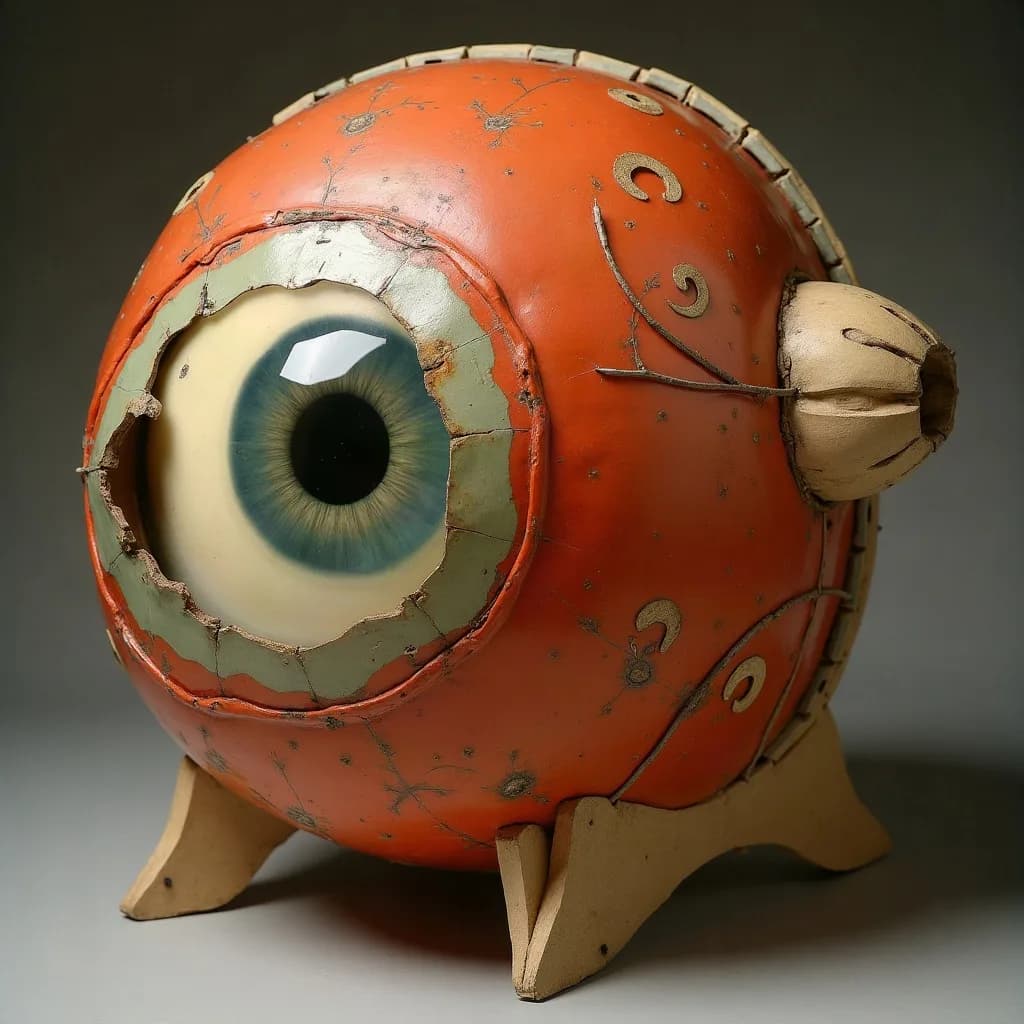
Oversized anatomical teaching model of the human eye, c. 1930
A German pupil-teaching model of the human eye, roughly ten times life size, disassembles into seven hand-painted parts.
- SKU
- MS-CU-1010
- Era
- 1900-1950
- Condition
- Good; original paint with expected craquelure, one lens element loose but present.
- Dimensions
- 11 in. H on stand × 8 in. dia.
- Weight
- 6.9 lb
- Provenance
- Deaccessioned from a small liberal-arts college biology department, upstate New York, 2022.
- Category
- Curiosities & Oddities
- Tags
- anatomical-modelmedicalteachingcabinet-of-curiositiesgerman
A German medical-school teaching model of the human eye, produced c. 1930 in painted plaster and papier-mâché over a wire armature, roughly ten times life size. Disassembles into seven parts — sclera, cornea, iris, lens, vitreous body, retina, and optic nerve stub — each hand-painted with anatomical accuracy startling for the price bracket it originally occupied.
Bears the partial paper label of a Leipzig scientific-supply house on the interior of the sclera. One lens element is loose in its seating but present and complete.
Sits on the supplied turned-oak stand and stares, mildly, at whatever is opposite it. We have found this to be either charming or unsettling depending entirely on the viewer, and we take no position on the matter.
Related finds
More from Curiosities & Oddities →
A 9-inch fragment of narwhal tusk, engraved with a whaleboat scene and inked in the manner of mid-century American scrimshaw.

Coin-operated fortune-teller by Mills Novelty Co., Chicago. Feeds a penny, dispenses one of 96 printed fortunes.

French singing bird box by Blaise Bontems. Lid springs open; feathered bird sings, turns, and blinks before retreating.